Play Sudoku Online: Free Sudoku Puzzles
Play free sudoku online, instantly and with no sign-up. Pick a level from easy to evil and give your brain a daily workout.
Free sudoku online, anytime and anywhere
Welcome to Sudoku-IT, a clean and simple place to play sudoku online and enjoy free sudoku puzzles. There’s nothing to download and no account to create: open the page, choose a level and start playing. It works on desktop, tablet and phone, and your game is saved automatically in your browser, so you can close the page and pick up exactly where you left off.
Every puzzle is generated on the spot and has exactly one solution, checked by our solver before you see it. That means every grid can be finished with pure logic, with no guessing required. You can choose from five levels, from easy sudoku for beginners to evil sudoku for players who want a real challenge, plus a daily sudoku that’s the same for everyone.
How to play sudoku: the rules in one minute
Sudoku is a logic puzzle played on a 9×9 grid that’s divided into nine 3×3 boxes. Some squares already contain numbers when you start. Your job is to fill in the rest. There are only three rules:
- every row must contain the numbers 1 to 9, with no repeats;
- every column must contain the numbers 1 to 9, with no repeats;
- every 3×3 box must contain the numbers 1 to 9, with no repeats.
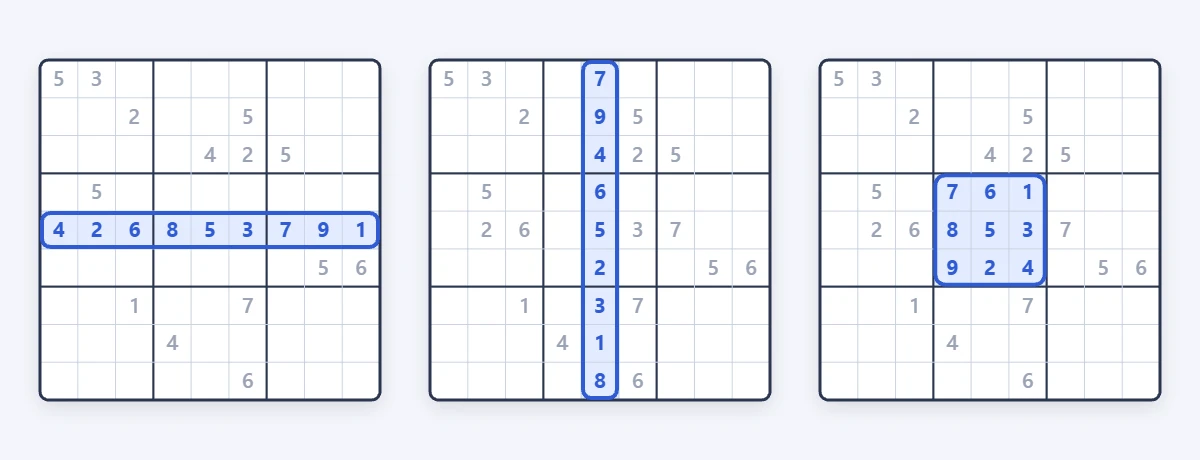
You don’t need to be good at math. The numbers are just symbols and could just as well be letters or colors; what matters is reasoning. To play sudoku online above, tap an empty square and then a number on the keypad, or use your keyboard. A wrong number turns red and counts as a mistake. After three mistakes the game ends, but you can take a second chance and keep going.
Difficulty levels: from easy sudoku to evil sudoku
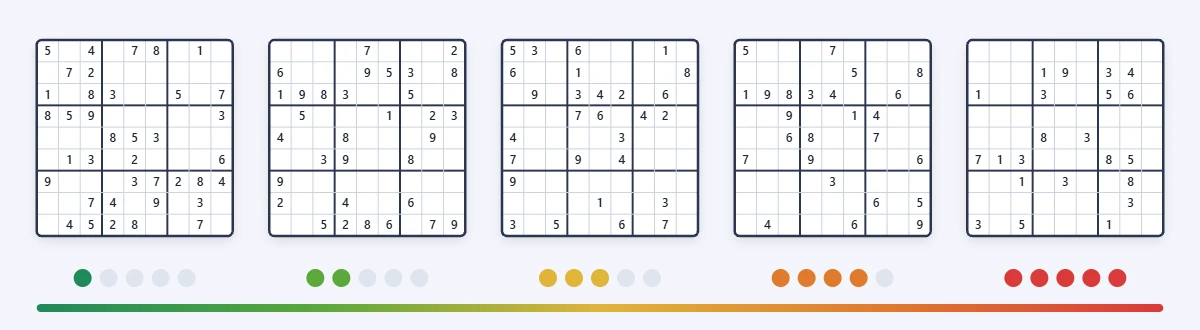
How hard a sudoku is doesn’t depend only on how many numbers you start with. What really matters is which solving techniques you need. Here’s how our levels work:
| Level | Starting numbers | Who it’s for | What you’ll need |
|---|---|---|---|
| Easy | about 38 | Beginners and kids | Simple row and column scanning |
| Medium | about 32 | Players who know the rules | Hidden singles and a little patience |
| Hard | about 28 | Regular players | Pencil marks and locked candidates |
| Expert | about 25 | Experienced solvers | Naked pairs and longer chains of logic |
| Evil | 22–24 | Anyone hunting the hardest sudoku | Advanced techniques like X-Wing and XY-Wing |
Easy and medium sudoku
Easy sudoku is perfect for learning. Lots of numbers are already in place, and almost every square can be solved by looking at its row, column and box. Medium sudoku asks for a bit more attention, because some squares only open up after you’ve filled in others. It’s ideal for a coffee break.
Hard and expert sudoku
In hard sudoku, notes become essential. Writing the possible candidates in each square helps you spot patterns you’d miss at a glance. Expert sudoku raises the bar again: you’ll need multi-step reasoning and the ability to work across several boxes at once.
Evil sudoku: the toughest level
Evil sudoku starts with very few numbers, usually 22 to 24. It’s the level for players who have already solved dozens of grids and want to test themselves with advanced techniques. Don’t be discouraged if you get stuck at first. That’s normal, and it’s exactly what makes it satisfying.
Daily sudoku
Every day at midnight there’s a new daily sudoku of medium-to-high difficulty. It’s the same grid for every player, so you can challenge friends or coworkers to see who solves it first. To play, just press the ★ Daily Sudoku button above the grid, then come back tomorrow for a fresh one.
Features of our online sudoku
We studied the best sudoku websites and brought the most useful features together in one place, without the clutter:
- Notes (pencil mode): jot down candidate numbers in any square. When you place a correct number, matching notes in the same row, column and box are cleared automatically.
- Hints: three per game, each one revealing the correct number in the selected square.
- Unlimited undo: step back as many moves as you like.
- Mistake counter and second chance: three mistakes allowed, plus one extra chance if you want to keep going.
- Smart highlighting: the row, column and box of the selected square light up, along with every matching number.
- Number counter: under each digit you can see how many are left; once a number is complete, it disappears.
- Timer and pause: track your time and pause whenever you want. The clock also stops when you switch tabs.
- Autosave and stats: games won and best time for each level, saved on your device.
- Printable sudoku: the Print button creates a paper version of the puzzle, with the solution upside down at the bottom of the page.
Keyboard shortcuts
| Key | Action |
|---|---|
| 1–9 | Enter a number in the selected square |
| Arrow keys | Move around the grid |
| Delete / Backspace / 0 | Clear the square |
| N | Turn notes on or off |
| H | Use a hint |
| Z or Ctrl+Z | Undo the last move |
| P | Pause or resume |
Printable sudoku
Prefer pen and paper? Every puzzle on this page is also a printable sudoku. Choose a level, start a new game and press Print: you get a clean, full-size grid ready for your printer, with the solution printed upside down at the bottom so you can check your work without spoiling it. It is perfect for commutes, classrooms or a quiet coffee break away from screens.
How to solve sudoku: strategies from beginner to advanced
Every sudoku expert started with the same basic techniques. Learn them in order; each one unlocks the next level.
Beginner techniques
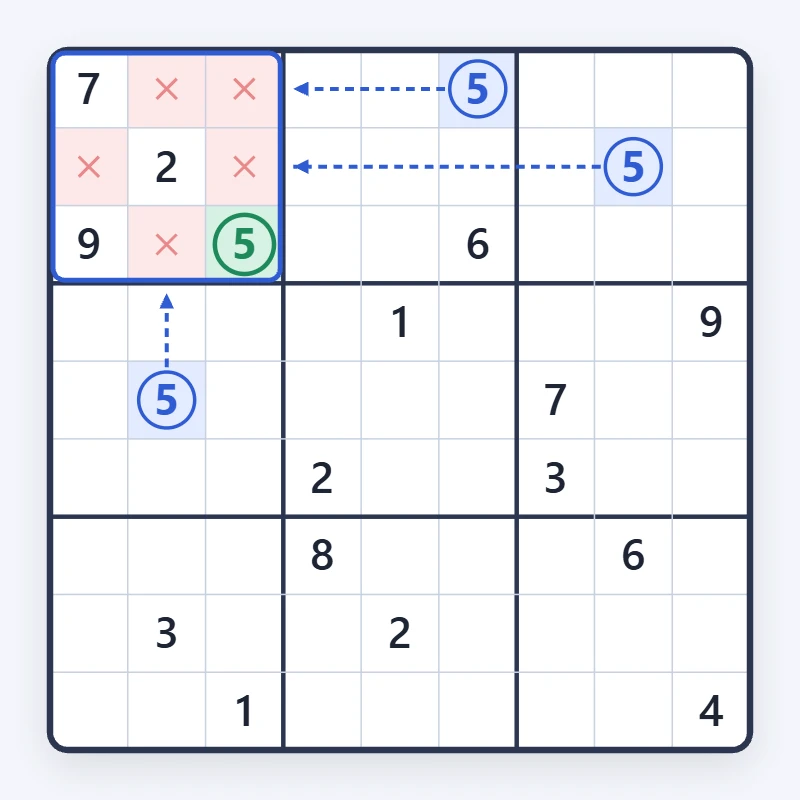
- Scanning: pick a number, say 5, and look at where it already appears. Each 5 rules out its row, column and box. If only one square in a box is left for the 5, you’ve found its spot.
- Hidden single: within a row, column or box, a number fits in only one square, even if that square has other candidates too.
- Naked single: a square where, after ruling out every number already in its row, column and box, only one candidate is left.
Intermediate techniques
- Locked candidates (pointing): if a number can only go in one row within a box, you can remove it from the rest of that row in the other boxes. The same works for columns.
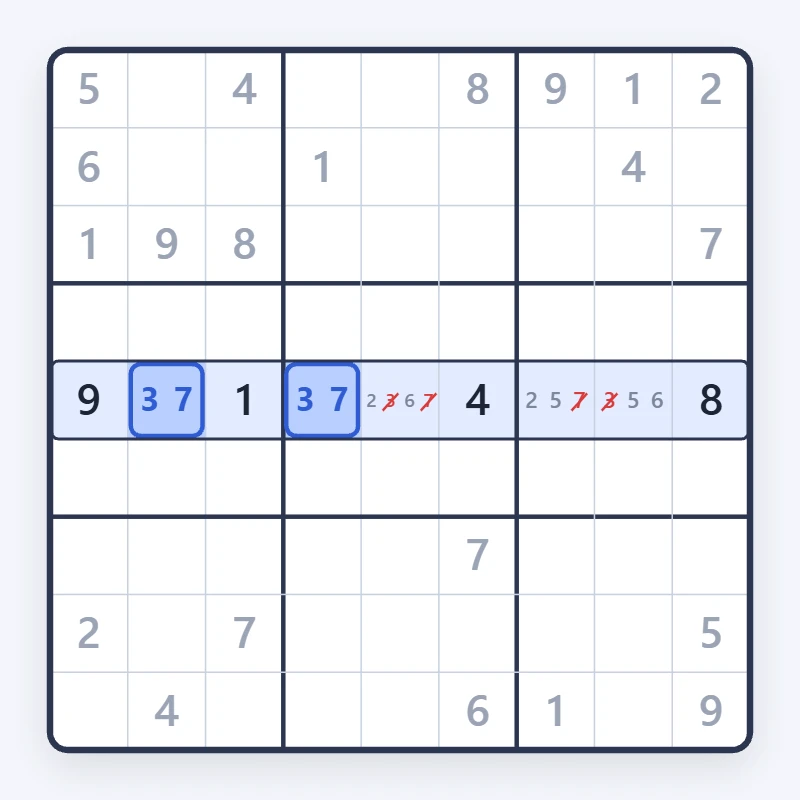
- Naked pairs: if two squares in the same unit have exactly the same two candidates, say 3 and 7, those numbers must go there. You can then remove 3 and 7 from every other square in that unit.
- Hidden pairs: if two numbers can only go in the same two squares of a unit, those squares must hold those two numbers, and you can clear all other candidates from them.
Advanced techniques for evil sudoku
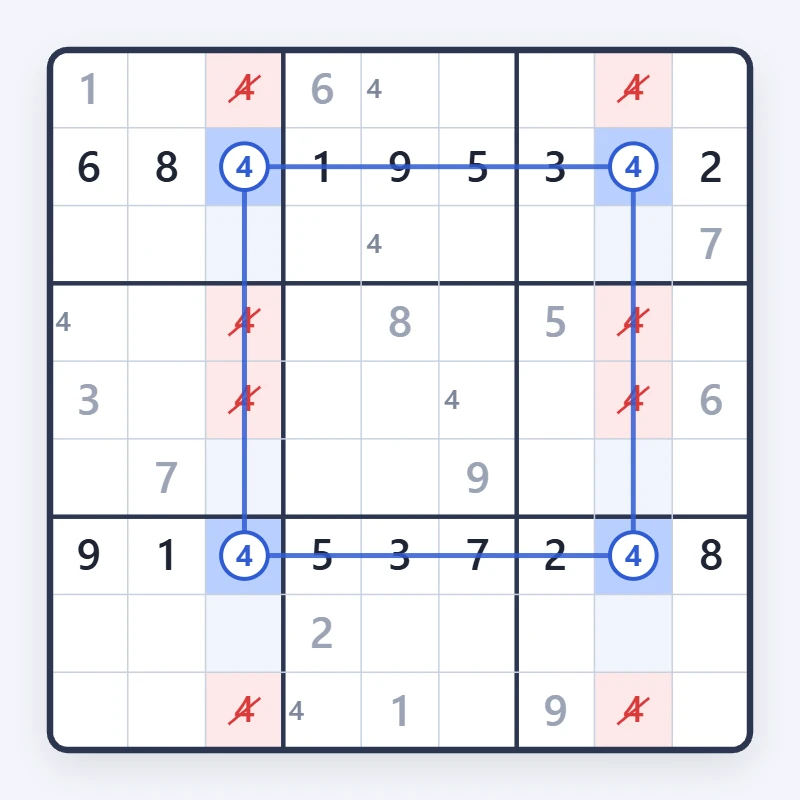
- X-Wing: if a number can only go in two squares in each of two rows, and those squares line up in the same two columns, the number sits on the corners of a rectangle. You can remove it from the rest of those two columns.
- Swordfish: the same idea as the X-Wing, extended to three rows and three columns. It’s harder to spot but follows the same principle.
- XY-Wing: three squares with two candidates each, in the pattern XY, XZ and YZ, where the first square “sees” the other two. Whatever the first square turns out to be, Z ends up in one of the other two, so any square that sees both can’t be Z.
7 tips to get better at sudoku
- Start with the numbers that appear most often in the grid. They’re the easiest to place.
- Work through boxes, rows and columns systematically instead of jumping around.
- Use notes when you get stuck, but don’t fill every square with candidates too early.
- Don’t guess: every well-made sudoku can be solved with logic.
- After placing a number, check its row, column and box right away. Another square often opens up.
- If you’re stuck, take a short break. Fresh eyes see more.
- Move up a level once you can finish the current one without hints. You’ll improve fast.
Why sudoku is good for you
Sudoku is a simple pastime, but it exercises several skills at once. It trains focus, reasoning by elimination and holding several pieces of information in mind at the same time. Plenty of people also play it to unwind: ten minutes with an easy grid makes a nice break between tasks.
Like any logic game, sudoku is a good way to keep your mind active at any age. It isn’t a miracle cure, but it’s an enjoyable, free habit that anyone can pick up, from kids to grandparents.
A short history of sudoku
Despite its Japanese name, sudoku has Western roots. In the 18th century, Swiss mathematician Leonhard Euler studied “Latin squares,” grids where each symbol appears once in every row and column. The modern puzzle, though, was born in the United States in 1979, when architect Howard Garns published it in Dell puzzle magazines under the name Number Place.
In 1984 the Japanese publisher Nikoli introduced it in Japan as Sūji wa dokushin ni kagiru (“the numbers must be single”), soon shortened to Sudoku. It became a worldwide hit in 2004, when New Zealander Wayne Gould persuaded the British newspaper The Times to print it. By 2005 sudoku had spread to newspapers across the UK and the US, and it has been a daily favorite ever since.
Fun facts about sudoku
- There are about 6.67 × 10²¹ different completed 9×9 sudoku grids. Once you remove symmetries, roughly 5.47 billion are truly distinct.
- A sudoku with a unique solution needs at least 17 starting numbers. A team of researchers proved this in 2012 with an exhaustive computer search.
- There are many variants, including killer sudoku, which mixes logic with sums, samurai sudoku with five overlapping grids, and sudoku X with diagonals.
- Smaller 4×4 and 6×6 versions are great for kids who are just learning the rules.
Sudoku online FAQ
How do you play sudoku online?
Select an empty square and enter a number from 1 to 9 using the keypad or your keyboard. Every row, column and 3×3 box must contain each number from 1 to 9 exactly once. When the grid is complete and correct, you’ve won.
Is sudoku online on Sudoku-IT free?
Yes, every level and the daily sudoku are completely free, and you can play as many games as you like.
Do I need to sign up?
No, there’s no sign-up. Your current game and stats are saved automatically in your device’s browser.
Can I play sudoku on my phone or tablet?
Yes, the grid adapts to any screen. It works on phones, tablets and computers without downloading an app.
What is the hardest sudoku level?
Evil. It starts with only 22 to 24 numbers and requires advanced techniques such as X-Wing and XY-Wing.
Does every sudoku have only one solution?
Yes. Our solver checks every puzzle to make sure it has exactly one solution that can be reached with logic alone.
What happens if I make three mistakes?
The game stops, but you can take a second chance and continue with one extra mistake, restart the same puzzle or start a new one.
Can I print a sudoku?
Yes, press the Print button to get a printable version of the puzzle, with the solution upside down at the bottom of the page.
What is the daily sudoku?
A new puzzle every day that’s the same for all players. Start it with the Daily Sudoku button and come back tomorrow for the next one.
What is the minimum number of clues in a sudoku?
A sudoku with a single solution needs at least 17 starting numbers. This was proven in 2012.
Start playing sudoku online now
You’ve got everything you need: rules, strategies, tips and a grid ready to go. Scroll back to the top, choose your level and start your next game of free sudoku online. And if you love a challenge, don’t miss the daily sudoku. There’s a new one waiting for you tomorrow.